


A team of young researchers Karazin Institute of Ecology, Green Energy and Sustainable Development became winners of the competitive selection for fundamental and applied research projects funded from the state budget. In accordance with the Order of the Ministry of Education and Science of Ukraine dated 09.01.2026 No. 22, the winning projects of the competition were identified, including the research work “Pathways for the Restoration of Green-Blue Infrastructure in Frontline Cities.”
The research team of the project consists of graduates from the INTENSE Doctoral School: Anastasiia Klieshch, Svitlana Burchenko, and Alina Hrechko. It is INTENSE, as an integral component of the SUNRISE project, that has ensured the formation of a new generation of researchers capable of implementing European standards and innovative approaches in restoring the environment of frontline territories.
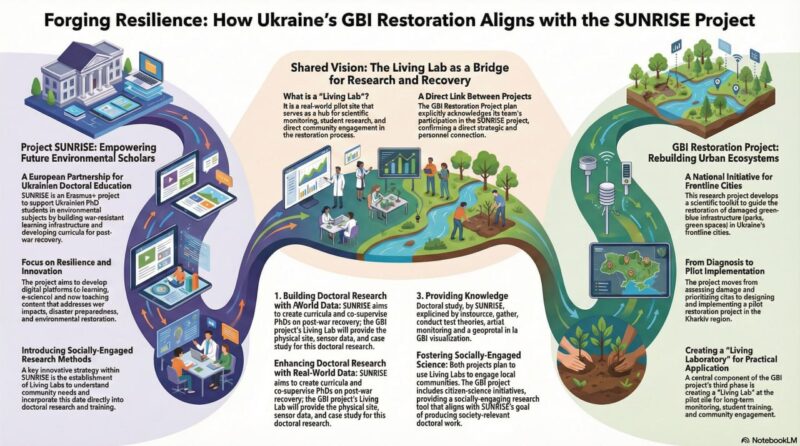
The SUNRISE project (Supporting Ukraine’s Next Generation of Researchers: A Project for Improving Scholar Education) proudly announces its support for the applied research work of young scientists “Pathways for the Restoration of Green-Blue Infrastructure in Frontline Cities” (State Registration Number: 0126U000993, implementation period: 2026-2028). By focusing on the unique challenges of war-affected urban environments, this research project provides the scientific content and participatory methods for restoring green-blue infrastructure that SUNRISE seeks to institutionalize throughout the Ukrainian higher education system. The synergy between SUNRISE’s educational innovations and the applied developments of young researchers is revealed in the key aspects of the research project’s implementation, which we invite you to explore further.
Adapting Science to War Realities
Traditional urban planning is often ill-equipped for the challenges of frontline territories. This applied research introduces a landscape-ecological planning (LEP) methodology specifically adapted to assess war-induced chemical pollution, biodiversity loss, and the destruction of drainage systems. By focusing on ecosystem services—such as dust suppression and temperature regulation—the research provides decision-makers with a scientific basis for prioritizing restoration where it is most needed.
Development of Living Labs
The key synergy between the projects is born from a shared vision and the active implementation of Living Labs as platforms for interdisciplinary collaboration, competence development, and scientifically sound decision-making.
The GBI research project provides the physical and technical infrastructure for establishing a “Living Lab,” creating a functioning demonstration site in a pilot territory of the Kharkiv region, where:
Nurturing Doctoral Excellence
The project serves as a cornerstone for doctoral research training within SUNRISE through:
Through this alignment, SUNRISE ensures that the next generation of Ukrainian scholars is equipped with the tools, technologies, and community-centred approach necessary to restore the environmental safety of their country!